MCP
- First open-source date: 2024-11-25
- Official introduction: https://modelcontextprotocol.io/docs/getting-started/intro
- Note: This entry records the timing and phase significance of MCP in application engineering. Concrete integration details should be covered in the Guide.
What It Is
MCP (Model Context Protocol) is an open protocol that provides a unified interface for models to connect external tools, data sources, and workflows.
The problem it targets is not "is the model strong enough," but "how to connect AI applications to external capabilities with lower friction and higher reliability."
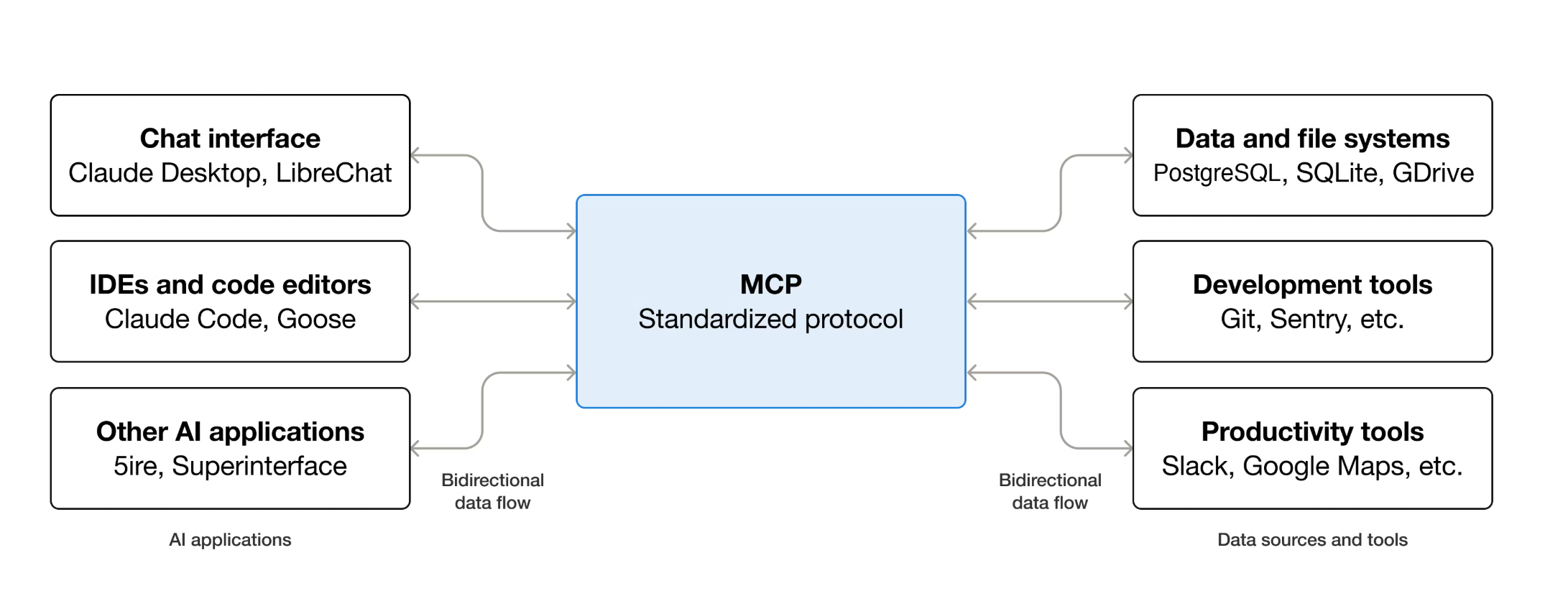
What Step It Moved AI Application Engineering From and To
MCP moves AI application engineering from "each product writes its own adapters and protocol glue" to "capability access organized around a shared protocol."
Before MCP, tool access was often private implementation detail inside each client, framework, and server. MCP started shifting this from fragmented integration work to a standardization problem at the infrastructure layer.
That is why it belongs on the timeline: it is not a single product feature update, but an attempt to rewrite the interface layer of the AI agent ecosystem.
What Stage It Is In Now
I currently mark MCP as emerging.
It already has strong ecosystem momentum and growing adoption across clients, developer tools, and servers. But it has not yet fully settled into a truly universal, low-friction, default industry interface standard.
In short, MCP is no longer just "a protocol proposal," but it is not yet at the "as unquestioned as HTTP" stage.
What It Might Replace
It can replace portions of private, fragmented, one-off integration layers, moving model-to-tool integration from isolated implementation to shared protocol collaboration.
If this direction succeeds, external capability access for agents becomes more like standard interface engineering and less like disposable glue code.
What Might Replace It
If a lighter, more constrained, and more cross-client compatible capability standard emerges, MCP itself may be replaced by a next-generation protocol layer.
There is still room to evolve or be outcompeted, especially around permission models, authentication, realtime behavior, and deployment complexity.